The renowned medical expert of the Yuan Dynasty, Zhu Zhenheng, once stated in “Danxi’s Medical Canon”: “Rather than seeking treatment after illness occurs, it is better to maintain health before illness sets in.” Since ancient times, people have been pursuing the preservation and prolongation of life. With the progress of society and the development of new media, health preservation knowledge has been disseminated through an increasing number of channels.
Lorem Ipsum has been the industry’s standard dummy text ever since the 1500s.
What is the Shanzhong acupoint?
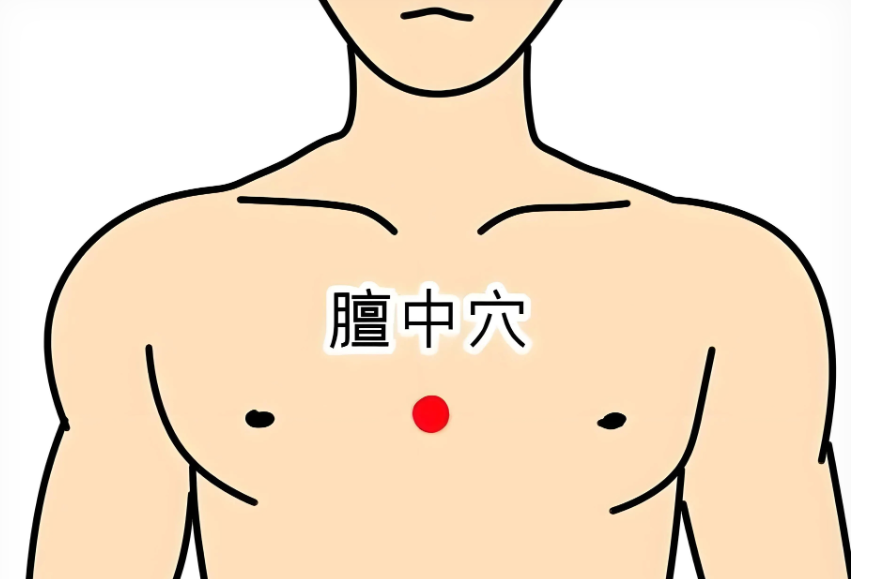
The Shanzhong acupoint, also known as “Upper Qi Sea”, “Yuan’er”, “Tongtang” and others, is located at the midpoint between the two nipples, where it can be reached by folding the skin and pressing down, or by lifting the chest and reaching in. “Shanzhong” was first mentioned in the “Ling Juanci – Root Loops”, stating that “The gallbladder meridian originates at the large bump, converges at the jade pearl, and connects at Shanzhong”. Moreover, since the Shanzhong acupoint is located in the chest and is the sea of primordial qi, and “Qi gathers at Shanzhong”, it can effectively regulate the qi circulation throughout the body. Any diseases caused by imbalanced qi circulation, such as lung qi not descending, stomach qi rising upward, liver qi not being relaxed, and heart qi being stagnant, can be treated and relieved by selecting Shanzhong. Additionally, the “Shanzhong” acupoint is mentioned in the “Shu Zang – Secret Canon of Meridians” as “The Shanzhong is the official organ that governs emotions and allows joyous expressions to emerge.” This means that the Shanzhong acupoint is adept at regulating emotions and can be used to alleviate disorders such as qi stagnation, blood stasis, and phlegm coagulation caused by emotional distress.
In the short video shared by Sun Li, if one is feeling angry, agitated, depressed, furious, or experiencing intense anger, they can use the “chest pounding” method to release their emotions. This method actually involves hitting the Zhongchong acupoint in the center of the chest. Through massage or gentle tapping, it aims to expand the chest, regulate the qi, adjust the mood, and divert attention, thereby dispelling negative emotions and making the mood become cheerful and positive.
The Secret of the Spleen Region
The Shanzhong acupoint not only helps regulate one’s emotions, but also has many other important functions. Firstly, the Shanzhong acupoint is located in the chest and is the convergence point of the primordial qi. Its position corresponds to the lungs, which are the main organ of qi in the human body. Therefore, diseases of the lungs can be treated by stimulating the Shanzhong acupoint. As recorded in “Emergency Thousand Gold Essentials”, “For coughing and shortness of breath,灸 (heat therapy) Shanzhong for fifty times” indicates that lung diseases should be treated by stimulating the Shanzhong acupoint. Additionally, “The Complete Collection of Acupuncture and Moxibustion” also lists the lung-related symptoms that the Shanzhong acupoint is responsible for, such as asthma, coughing, and lung abscess. Modern clinical research has found that acupuncture at the Shanzhong acupoint can significantly improve the airway obstruction and breathing difficulties of patients with chronic obstructive pulmonary disease. Moreover, applying an acupoint patch at the Shanzhong acupoint can reduce the frequency of asthma attacks in children and inhibit the progression of the disease. Thus, stimulating the Shanzhong acupoint can invigorate the lung qi and relieve wheezing and coughing. It is widely used in clinical practice for respiratory system disorders.
The Shanzhong acupoint is a meridian point of the heart envelope. The heart envelope can act as a substitute for the heart to receive external pathogenic factors, which helps to relieve chest tightness, promote qi circulation, activate blood circulation and unblock meridians. Therefore, it has significant therapeutic effects on cardiovascular diseases such as chest pain and heart disorders. According to the “Emergency Thousand Gold Essentials”, treating chest pain and heart disorders can involve acupuncture and moxibustion at the Shanzhong point for 100 times. Modern clinical observations have found that combining the Shanzhong point with the Neiguan point, the heart俞 point, and others for treatment also has a remarkable effect in combating atherosclerotic coronary heart disease. This is because the Shanzhong point is not only a meridian point of the heart envelope, but also the two are “complementary in terms of qi and blood generation and circulation”. At the same time, stimulating the Shanzhong point can calm the mind, calm the nerves, clear the heart and relieve restlessness. It can also be used for treating diseases such as restlessness and palpitations.
When the function of the liver is disrupted, it can easily lead to the obstruction of liver qi, resulting in a series of symptoms. The most common ones include depression of mood and “melon seed qi” syndrome. Since the course of the liver meridian of foot-jueyin runs along the “rib and chest area”, the imbalance of liver qi is prone to cause pain in the rib and chest region. This is especially true for women experiencing postpartum lactation deficiency or mastopathy, which are closely related to this issue. The “Difficult Classic” records that the location of the Shanzhong acupoint is one inch and six tenths of an inch below the Yutang acupoint, at the midpoint of the line connecting the two nipples. Based on the principle that “the location of the acupoint determines the treatment site”, using the Shanzhong acupoint for the treatment of such diseases has the effects of regulating liver qi, relieving depression, and promoting lactation. Acupuncture at the Shanzhong acupoint is beneficial for the secretion of prolactin and can improve the manifestations of postpartum lactation deficiency. Traditional Chinese medicine believes that the liver likes to be free and unobstructed and dislikes depression. If liver qi is obstructed and fails to be regulated, it will cause depression of emotions, poor circulation of qi and blood, and common symptoms such as belching, chest pain, and depression of spirit. The treatment principle is mainly to regulate liver qi and relieve depression. The Shanzhong acupoint is the first choice, and it is often combined with the Taiyang acupoint of the liver meridian for application.
According to traditional Chinese medicine, the stomach is one of the six major organs. Its qi should be downwardly regulated. If the stomach fails to maintain harmony and downward flow, the qi will rise upward and cause symptoms such as nausea, vomiting, hiccups, and dysphagia. The Zhongxin acupoint, as an important acupoint for regulating qi, can regulate the qi circulation throughout the body. The “Thousand Gold Supplementary Formulas” records: “Treat sudden hiccups by moxibustion at Zhongxin.” For such diseases caused by the disorder of stomach qi, the Zhongxin acupoint can also be selected for corresponding moxibustion treatment to relieve chest tightness, facilitate breathing, regulate qi, and reduce turbidity.
The massage of the Zhongchong acupoint should be done properly.
In ancient medical texts, when treating diseases by using the Zhongchong acupoint, due to the limited understanding of the anatomical structure of this point, considering that it is located close to the heart and it is difficult to control the needle insertion angle and depth, most cases adopted moxibustion therapy. In recent times, with the infiltration of Western medical anatomy, the safety of the Zhongchong acupoint has gradually improved. Currently, in clinical practice, the operation of this point is no longer limited to moxibustion treatment. New methods and techniques are constantly emerging, such as penetrating needle therapy, bleeding and cupping with needles, kneading, and drug application.
If the method of pressing and rubbing the Shanzhong acupoint is adopted, one can assume a supine position or a sitting position. Use the thumb or middle finger of one hand to apply force and rub the acupoint on the Shanzhong point. The other four fingers can be kept in a clenched fist, and the wrist joint should rotate slowly, continuously and gently. You can first alternate clockwise and counterclockwise directions for rubbing. The force should be moderate, and the technique should be gentle and uniform. Perform this massage once in the morning and once in the evening every day, for 3 to 5 minutes each time. Or as shown in the short video, gently tap the Shanzhong acupoint with your hand. However, it should be noted that the Shanzhong acupoint must not be struck forcefully, otherwise it will cause the qi in the body to spread, causing restlessness, confusion of mind, and even serious consequences. Therefore, during the massage, one must master the correct technique and appropriate force.
* This is an affiliate link. After you register, I may receive a commission, and you won't be charged any additional fees.
No Responses